
Cause table
| Symptom | Cause | How to check | What to do |
|---|---|---|---|
| One side of the cut clean, the other dross-covered | Nozzle not concentric with the beam | Burn-paper test — is the mark round | Re-centre; if it will not centre, replace |
| Gas use up, quality down | The orifice has worn open | Compare the orifice to a new nozzle | Replace the nozzle |
| Collided with a tipped-up part, cuts poorly since | Nozzle deformed although it looks fine | Compare side by side with a new one | Replace — do not try to reshape it |
| Thick stainless, heavy burr, pressure already maxed | Orifice too small for this thickness | Check the thickness-to-orifice table | Go one size up; confirm gas flow capacity |
| Thin carbon steel with a double nozzle, persistent dross | Wrong nozzle type for the gas | Check whether it is single or double | Oxygen → double; high-pressure nitrogen → single |
Single or double
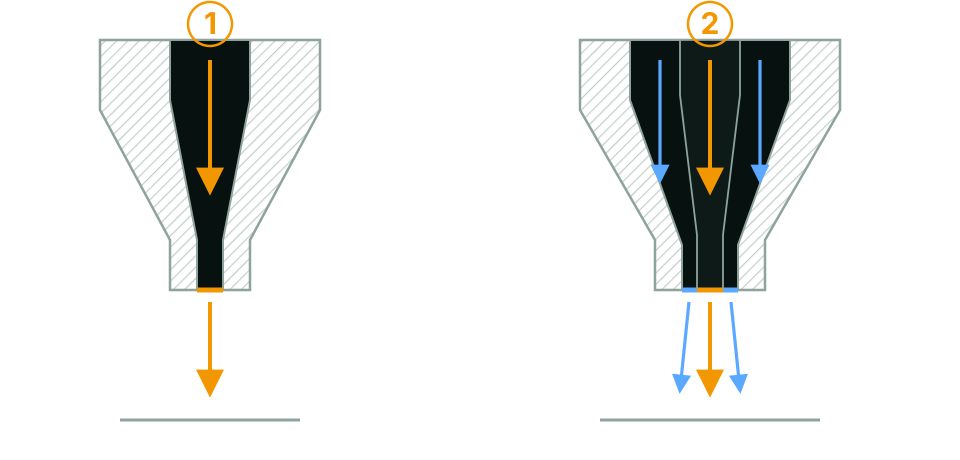
Double nozzles (two-stage orifice) produce an inner core plus an outer sheath of gas. Use with oxygen on carbon steel — the outer sheath stabilises the burn reaction and keeps the edge clean, especially on thicker plate.
Single nozzles (one orifice) produce a concentrated, high-pressure jet. Use with nitrogen on stainless and aluminium — here the gas does not react, it blows molten metal out of the kerf, and what you need is momentum, not shielding.
Use the wrong type and no parameter set will rescue the edge.
Orifice diameter
General rule: thicker material, larger orifice. A small orifice gives a more concentrated jet, good for thin sheet and small features; a large orifice gives higher flow, needed for thick plate.
But a large orifice consumes far more gas. This is where the gas budget is actually spent — see the gas consumption article.
Common mistake: running one orifice size for every thickness to avoid changing nozzles. The result is wasted gas on thin sheet and unclean cuts on thick.
The most commonly misjudged point
A nozzle that looks fine is not necessarily still round.
After one collision with a tipped-up part, the orifice can deform by a few hundredths of a millimetre — enough to skew the gas jet, not enough to see by eye. The symptom is one clean side and one dross-covered side, and the operator will spend a morning chasing parameters.
The burn-paper test takes thirty seconds and gives a definite answer: the burn mark must be round and concentric. Not round → replace the nozzle.
A nozzle is a consumable, not a spare part. Treat it like a welding tip or a saw blade: when it is done, replace it without hesitation.